McKinsey's 2026 global survey of 1,719 leaders across 97 countries found that just 6 percent of organizations qualify as AI high performers — companies attributing at least 5 percent of EBIT to their AI work. Everyone else is somewhere between enthusiasm and evidence.
That is the actual problem behind most AI ROI conversations. It plays out the same way whether the work is built in-house or bought in as AI development services. A tool gets deployed onto a process nobody changed, the productivity gains show up in how people feel rather than in the financials, and eighteen months later a CFO asks a question the sponsoring team cannot answer with numbers. But the measurement was never designed, the baseline was never captured, and the business case was written for a twelve-month horizon that this class of investment does not honor.
This guide covers what to do about it: a plain definition of return on AI and the hard/soft split that runs through the rest of the piece, and why measuring AI ROI is genuinely difficult. In addition, we will explain how generative and agentic systems pay back on different schedules, a five-step calculation framework with the full arithmetic worked through on a real-world example, and the KPIs worth instrumenting.
What Is AI ROI?
AI ROI is the financial return an organization earns on money it puts into artificial intelligence solutions, set against what that initiative actually cost to build and run. AI ROI looks like ordinary arithmetic: gain minus cost, divided by cost, expressed as a percentage.
A CFO reviewing a $2.4M model-deployment program wants one number that reconciles to the general ledger. The VP of Engineering who sponsored it is looking at a support queue where average handle time dropped from nine minutes to five and a half, which never appears in any ledger at all. Both are describing the same AI investment. Neither can produce the other's number on demand, and that gap — far more than model quality — is where most AI ROI conversations stall.
The numbers from the field say the same thing. McKinsey's State of AI global survey found that 80 percent of people using AI report improved personal productivity, while only 37 percent of organizations can attribute any EBIT impact to it. That second figure has not moved since the previous year. Productivity is being felt everywhere and banked almost nowhere.
Splitting the return into two categories is what closes the gap.
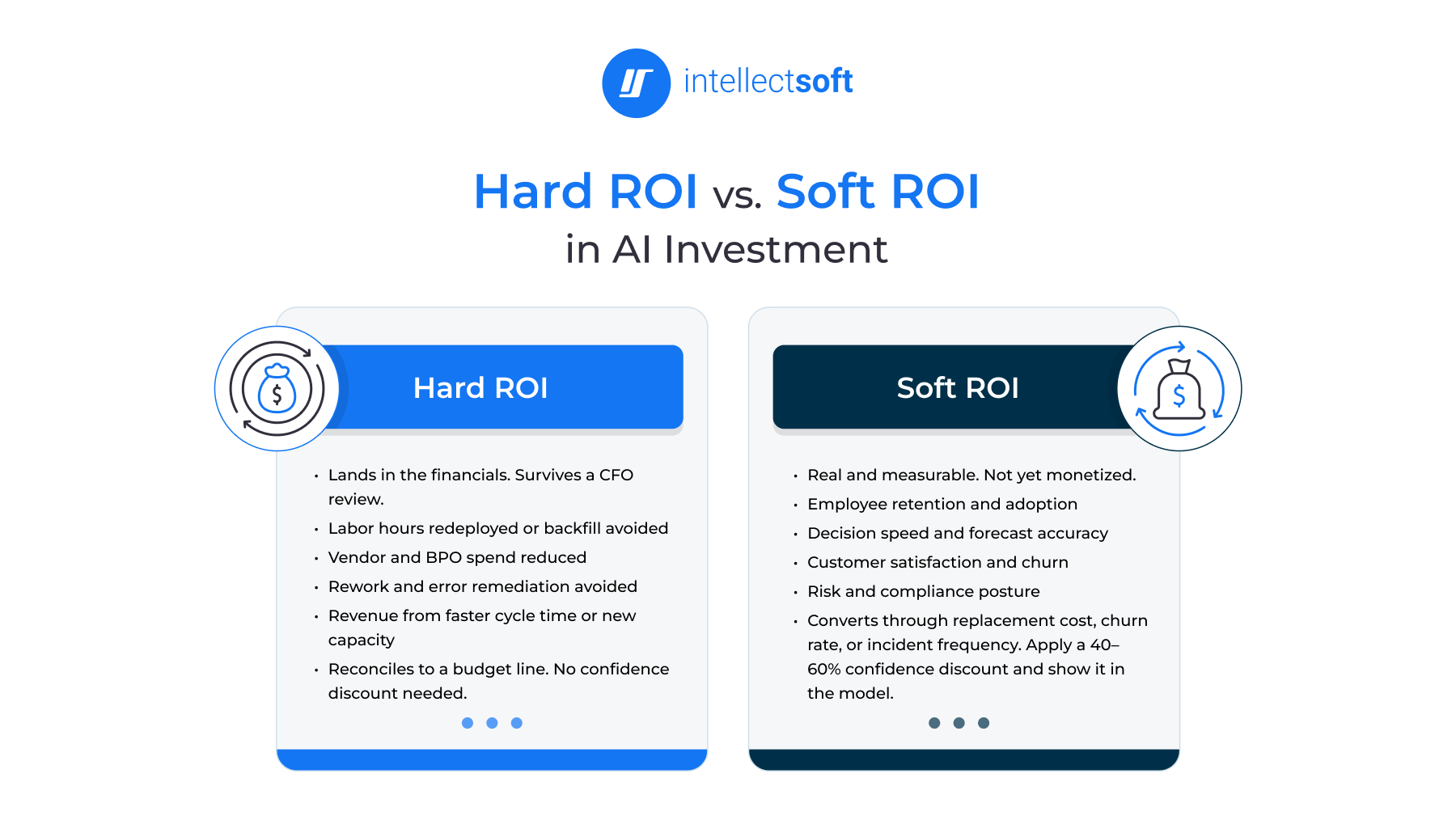
Hard ROI covers value that lands in the financials and survives a CFO's review. Contractor hours removed from a process. Cloud spend reduced after an inference workload was re-architected. Revenue from a pricing model that a forecasting system made possible. Each item traces to a line in a budget, and each one can be defended without narrative.
Soft ROI set a value that is real, measurable, and not yet monetized. Faster decision cycles. Lower attrition among engineers who stopped doing repetitive review work. Fewer compliance escalations because a document-checking system caught errors earlier. These metrics are trackable — the hard part is converting them into currency, and skipping that conversion is why so much AI investment looks like a cost center on paper.
To measure AI ROI, neither category is optional. A business case built only on hard ROI understates what an AI program does and usually fails to justify the second year of funding. One built only on soft ROI reads as advocacy to a board that has already seen three of them.
Why Is AI ROI So Hard to Measure?
Spending keeps climbing. Deloitte's 2025 survey of 1,854 executives across Europe and the Middle East found that 85 percent had raised AI investment over the prior twelve months. 91 percent intended to raise it again in the next twelve months. Returns are not climbing with it: only 6 percent of those organizations reported reaching ROI within a year.
The MIT NANDA study, The GenAI Divide: State of AI in Business 2025, put a sharper number on the same problem: roughly 95 percent of enterprise generative AI pilots stall without measurable P&L impact. It does not say the pilots produced nothing — it says nobody could trace what they produced to the income statement. The report's authors point to integration and organizational learning rather than model quality, and they note that companies were reluctant to disclose failures, so the sample has limits.
Five things make AI ROI genuinely hard to pin down, and none of them are solved by better models.
Intangible and Long-Term Benefits
An underwriting assistant cuts quote turnaround from four days to seven hours. Nobody was fired, no license was canceled, no line in the budget changed. Twenty months later, broker retention is up, and the renewal book is thicker — by then a pricing change and two new distribution partners have also landed, and no one can honestly say how much of that belongs to the assistant.
Value that arrives late and diffusely is still value. It fits badly into a fiscal-year ROI calculation, which is one reason the finance team quietly discounts it to zero.
Fragmented Data and Legacy Systems
A PMO tracks fourteen parallel AI initiatives. Three of them touch the same order-management system. Fulfillment accuracy improved 6 percentage points last quarter, and the three sponsoring teams each claim it. Nobody is lying — the instrumentation simply cannot separate them.
Attribution failure is typically an architecture problem in disguise, wearing a measurement suit. If the baseline lives in a warehouse last reconciled in 2019 and the AI output lives in a separate operational store, the before-and-after comparison desired by the CFO cannot be generated at all. The least glamorous barrier to AI ROI is also the most prevalent.
The Pilot-to-Scale Gap
Pilots are engineered to succeed. Clean data, a friendly team, a narrow use case, an engineer on call. Production has queue depth, edge cases, auditors, and people who did not volunteer.
McKinsey's 2026 survey found 44 percent of organizations scaling AI across the enterprise (up from 38%), but still under half. Gartner expects more than 40 percent of agentic AI projects to be canceled through 2027, citing rising costs and unclear value. A 300 percent return on a pilot with a $40k budget doesn't tell you much about the same system operating at 40x the volume with corresponding inference costs and human review.
Technology Evolving Faster Than the Metrics Used to Track It
A team defines its AI ROI framework in Q1 around tokens processed and tickets deflected. But by Q3 the workload has moved to an agent that plans multi-step actions across three systems, and tickets deflected no longer describes what the thing does. The dashboard keeps reporting. However, it is measuring AI ROI that no longer exists.
Model pricing shifts, context windows grow, and a capability that justified six months of engineering becomes a configuration setting in a vendor product. Metrics defined against last year's architecture quietly stop meaning anything, usually without anyone noticing.
The Human Factor
Adoption decides the return, and where forecasts die. A tool licensed for 900 people and opened by 210 of them returns a fraction of its business case, no matter how good the model is.
Measured effects also diverge from felt ones. In a randomized controlled trial by METR, sixteen experienced open-source developers worked through 246 real repository issues with and without AI assistance. They expected a 24 percent speedup. They were 19 percent slower with the tools — and afterward still believed the tools had made them 20 percent faster. The authors are explicit that the finding may not transfer to junior developers or unfamiliar codebases.
Self-reported productivity gains are the softest input in any AI ROI calculation, and they are the input most business cases lean on hardest.
Generative AI vs. Agentic AI ROI
Most business cases treat AI as one budget line. But it behaves as two, and the two pay back on completely different schedules.
Generative AI produces output a person then uses — a draft, a summary, a translated spec, a first-pass test suite. The unit of value is small and repeats constantly. That makes it cheap to measure: count the artifacts, price the hours they replaced, subtract the license and review cost. A marketing team producing 340 localized product descriptions a month, where the previous vendor charged $18 per description, has a defensible number by week six.
Agentic AI executes a sequence. It plans, calls systems, handles a failure, and comes back with a completed task rather than a draft. Value here is per-process, and a process only pays out once the whole chain runs without a human patching the middle of it.
That structural difference drives every measurement decision that follows.
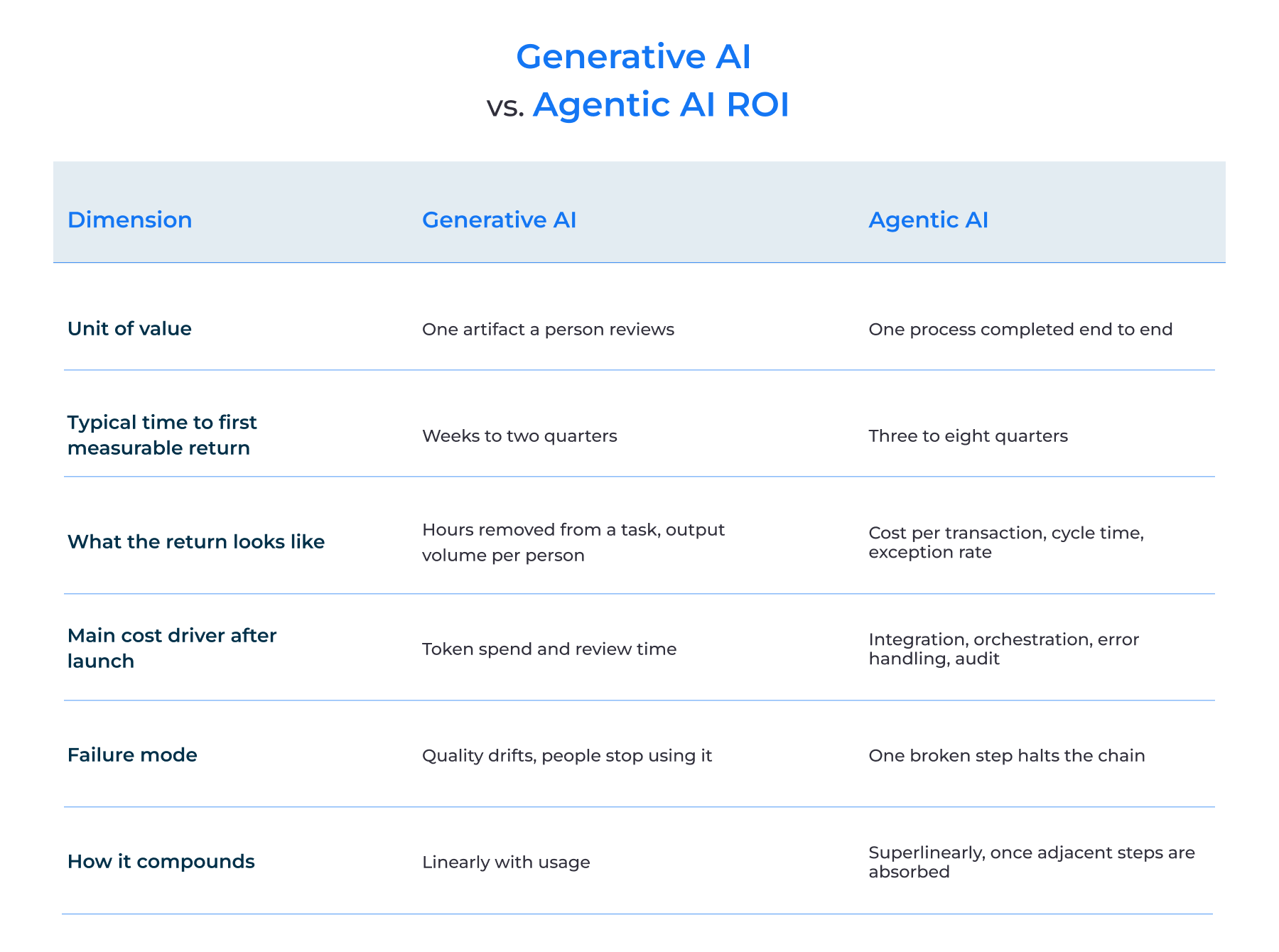
Generative AI returns scale roughly in proportion to use. Double the drafts, roughly double the saved hours, minus review time that never fully disappears. The curve is honest, and it flattens.
Agentic returns behave differently. An agent handling invoice matching starts by clearing the 71 percent of invoices that need no judgment. Six months on, the same orchestration layer picks up vendor onboarding, because the connectors, the audit trail, and the exception queue already exist. The second use case costs a fraction of the first. That is where AI ROI compounds, and it explains why agentic programs look expensive right up until they suddenly do not.
The market is at the front of that curve. McKinsey found 40 percent of organizations above $1B in revenue scaling AI agents in 2026, against 27 percent a year earlier. Gartner's caution is worth holding alongside it: of the thousands of vendors marketing agentic capability, the firm estimates roughly 130 are genuine, with the rest doing what its analysts call agent washing. Buying an "agent" that is a workflow tool with a chat window attached produces neither category of return.
Two practical consequences for how you measure AI ROI.
First, do not evaluate both on a twelve-month horizon. A generative use case that has not paid back within a year is probably a bad use case. An agentic program judged at the same checkpoint gets killed at exactly the point where integration work is finished, and the compounding is about to start. Deloitte's survey found 86 percent of the organizations getting real returns apply different measurement frameworks to the two — the single most transferable finding in that report.
Second, fund them from different logic. Generative AI is an efficiency investment with a short, checkable payback, and it should be held to one. Agentic AI is closer to infrastructure: the first process carries the platform cost, and the business case only closes when processes two and three are named in advance. Approving an agentic program with one use case in the plan is how a company ends up in Gartner's 40 percent.
How to Calculate AI ROI: A Practical Framework
The formula is constant:
AI ROI = (Total value delivered − Total investment) ÷ Total investment × 100
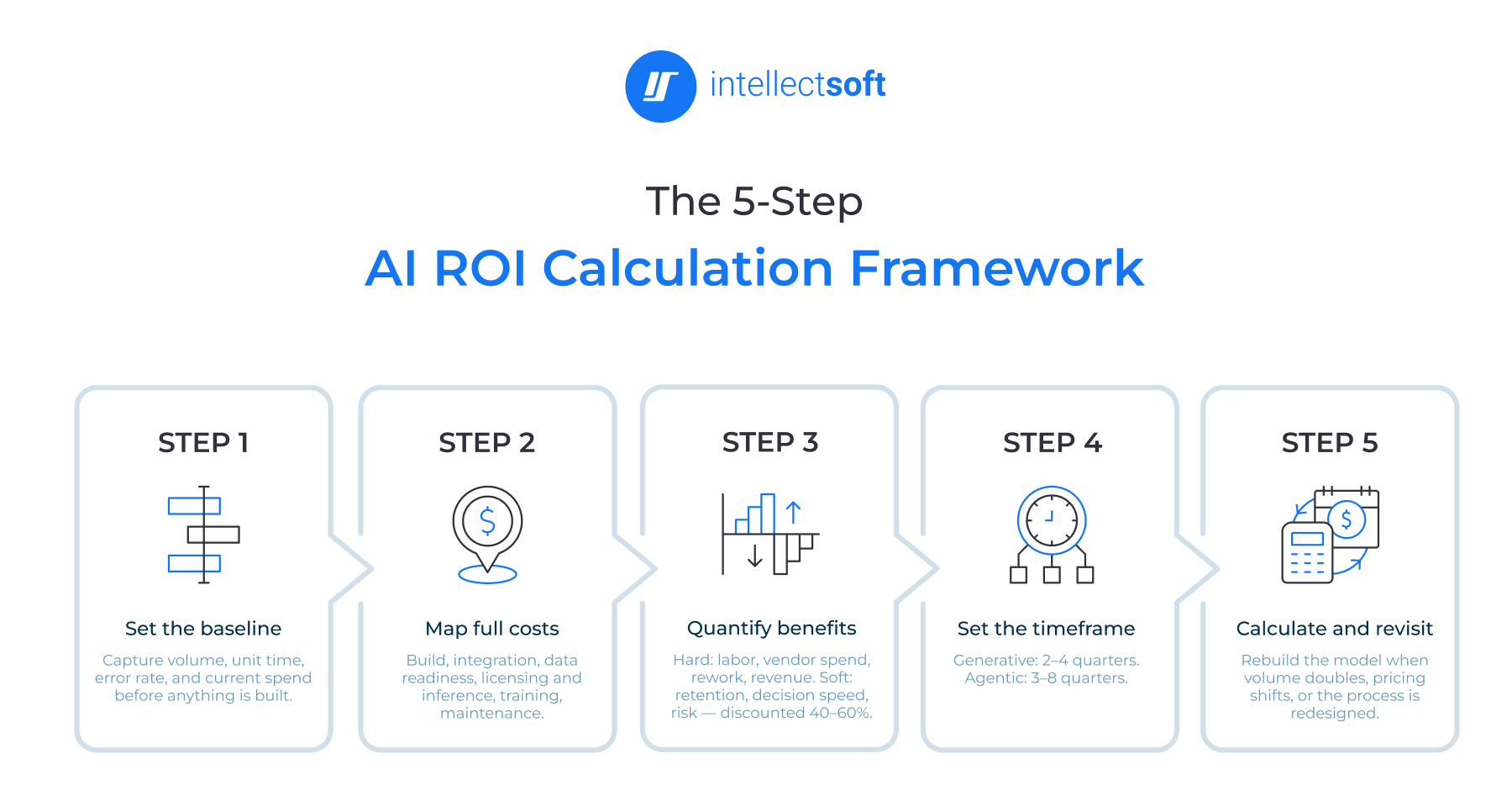
Everything difficult about calculating ROI sits inside those two inputs. This AI ROI framework fills them in through five steps, and a worked example at the end runs the arithmetic end to end.
Step 1 — Identify the Use Case and Set a Baseline Before You Start
Pick one specific process. For example, "Apply AI to customer service" produces no AI ROI anyone can verify. "Reduce manual document intake in claims first-notice-of-loss" can.
Capture the baseline while the old process is still running — without it, you cannot calculate ROI afterward at all. What you need is small and specific: current volume, current unit time, current error and rework rate, current fully loaded labor rate, current vendor spend on the same work. Two or three months of history beats a single snapshot — one busy quarter will otherwise become the number your ROI is measured against forever.
Baselines are the step teams skip under deadline pressure. Skipping it is the single most reliable way to end up unable to prove anything eighteen months later.
Step 2 — Map Full Costs
License price is the smallest line in most AI programs. A full AI investment breaks into six categories, and all six belong in the denominator:
- Build and engineering. Model selection, prompt and orchestration work, evaluation harnesses, security review.
- Integration. Connectors into the systems where the work actually happens. On legacy estates, this routinely exceeds the build itself.
- Data readiness. Cleanup, labeling, access control, and the pipeline that keeps the input current. Rarely budgeted, always paid.
- Licensing and inference. Model and platform fees, which scale with volume rather than with headcount. Consumption-based AI as a Service models move most of this out of capex, which flatters the first-year number and quietly raises the run-rate one.
- Training and change management. Enablement, documentation, and the productivity dip while people learn.
- Ongoing maintenance. Monitoring, drift checks, retraining, and the on-call rotation. Budget 15 to 25 percent of build annually.
One in five organizations in McKinsey's 2026 survey said AI operating expense had already constrained further adoption. Programs hit that wall when inference and maintenance were treated as rounding errors at approval time.
Step 3 — Quantify Benefits
Hard ROI first, since it carries the business case. Labor hours redeployed or backfill avoided, priced at fully loaded rates. Vendor or BPO spend reduced. Rework and error remediation avoided, priced per incident. Revenue attributable to faster cycle time or new capacity. Each of these reconciles to a budget line, and each survives audit.
Soft ROI second, quantified rather than asserted. Employee retention converts through replacement cost. Customer satisfaction converts through churn rate and account value. Risk reduction converts through incident frequency multiplied by average remediation expense.
Apply a confidence haircut to every soft figure — 40 to 60 percent is defensible — and show the haircut in the model. Showing the discount is what separates calculating ROI from advocating for a budget.
Step 4 — Set Realistic Timeframes
Judge a pilot on leading indicators. Adoption rate against licensed seats, output accuracy against a human baseline, unit time, exception volume. None of these are financial, and all of them predict whether the financial return will arrive.
Judge production on lagging financial metrics, and give them room. Deloitte's survey put typical AI ROI realization at two to four years, against seven to twelve months for conventional technology, with just 6 percent of organizations reaching return inside a year. A steering committee that demands positive ROI at month nine will cancel programs at their most expensive and least productive moment.
Match the horizon to the type of system, using the split from the previous section. Generative use cases owe you a number within two to four quarters. Agentic programs need three to eight, and the second and third process in the plan are what close the case.
Step 5 — Calculate, Benchmark, and Revisit
Here is the full arithmetic on an illustrative composite — a mid-market insurer automating document intake in claims. The figures here are constructed to show the method.
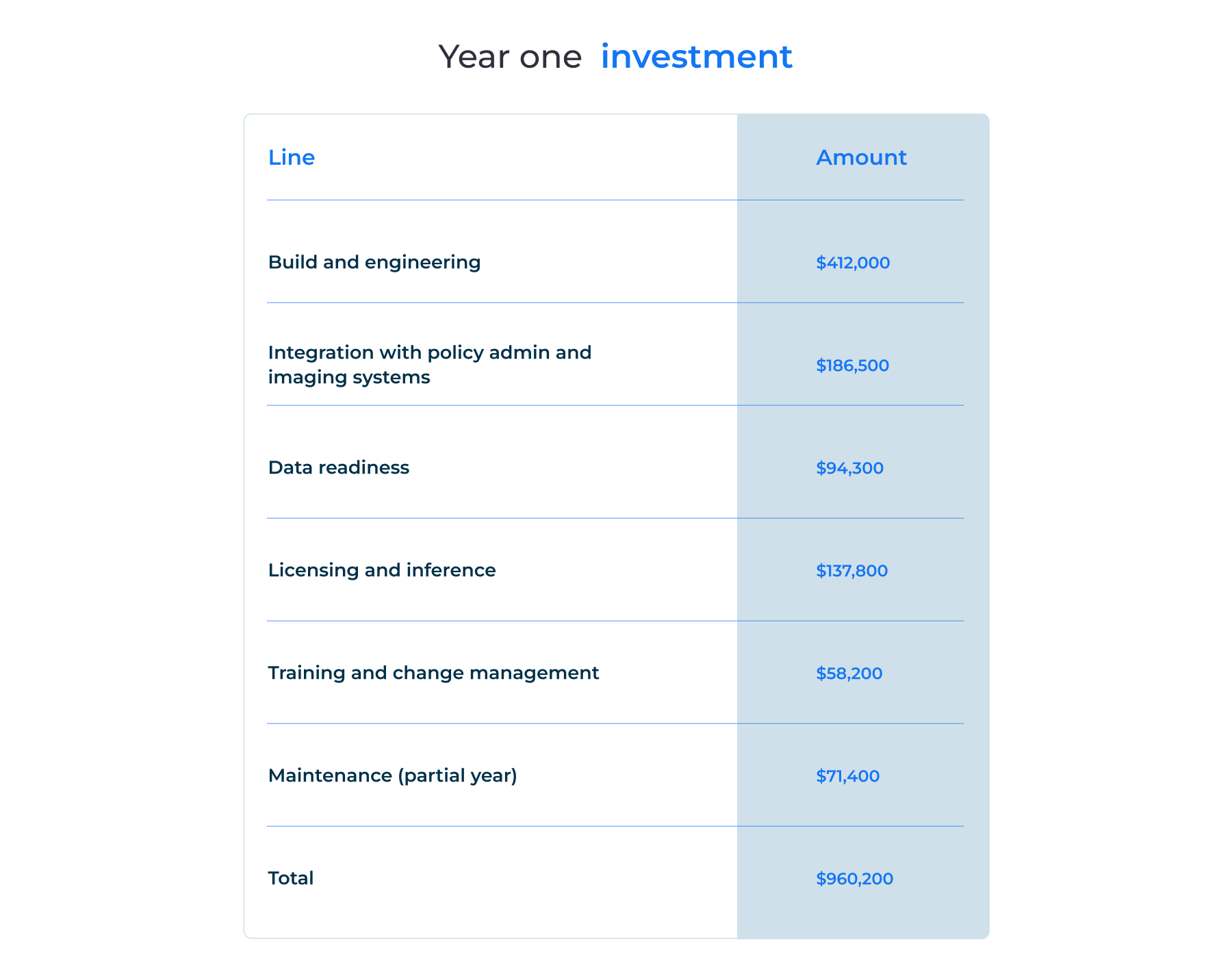
Year one investment
Year one value
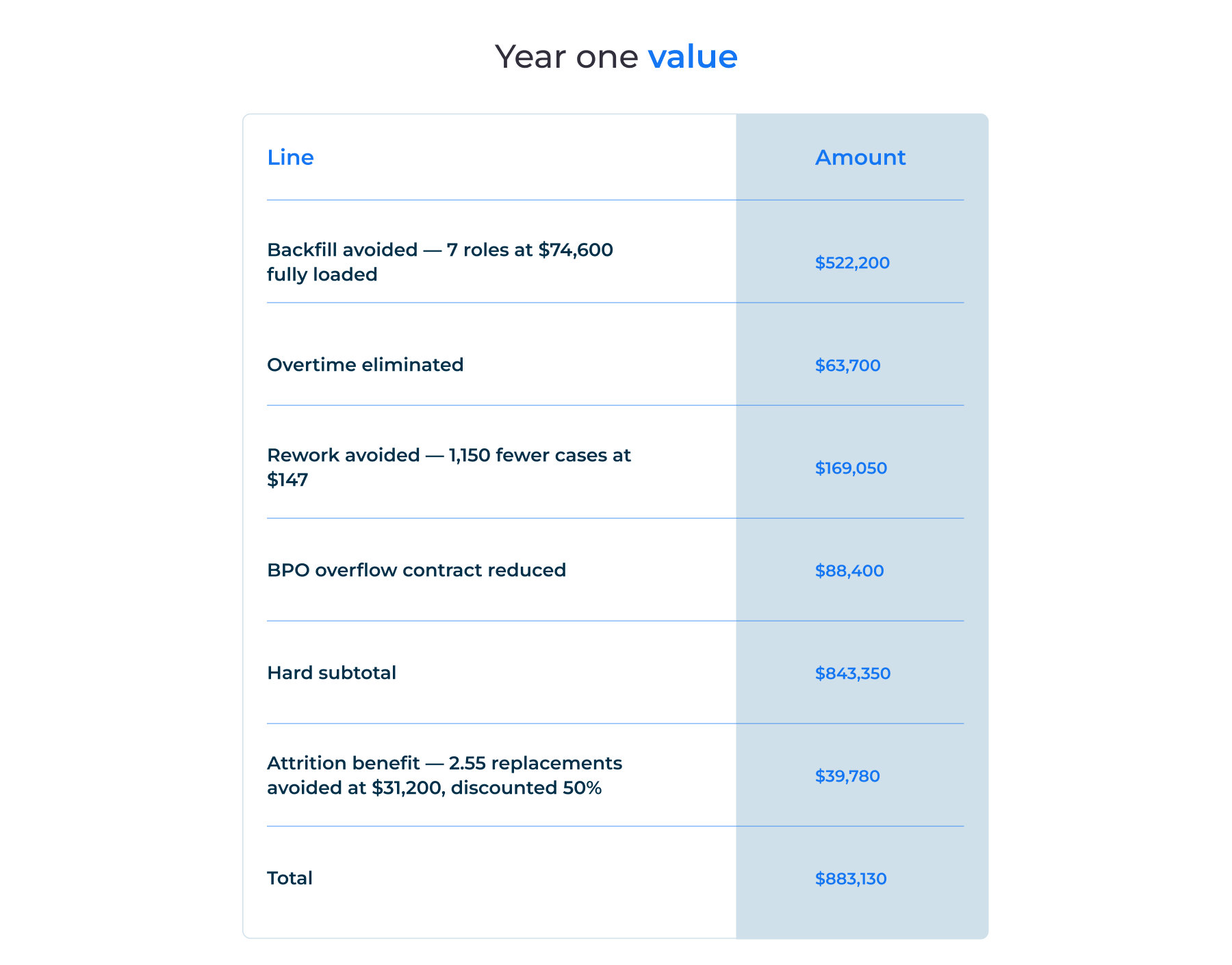
Year one AI ROI: ($883,130 − $960,200) ÷ $960,200 = −8%.
Negative. The program is not failing but carrying its build in a single year.
Year two removes build, integration, and data readiness from the denominator. Run-rate spend falls to $256,700. Value rises to $958,380 on a full year of production volume.
Year two AI ROI: ($958,380 − $256,700) ÷ $256,700 = 273%.
Two-year AI ROI: $1,841,510 of value against $1,216,900 invested, or 51%, with payback at roughly month thirteen.
A steering committee shown only year one kills it. A committee shown only year two is being sold to.
Benchmark the result against something real before presenting it. Your own prior automation projects are the best comparison available, since they share your data estate and your change-management overhead. Then calculate ROI again when volume doubles, when the pricing of your model provider changes, or when the process the system supports is redesigned. A calculation that has not been revisited in four quarters is describing a system that no longer exists.
Key AI ROI KPIs and Metrics to Track
A KPI earns its place by changing a decision. Everything else is dashboard decoration, and most AI programs carry far too much of it. Assign each one an owner who is accountable for the underlying process, since a KPI owned by the AI team measures the AI team.
Hard ROI KPIs
These reconcile to the general ledger.
Cost savings. Track avoided spend by category, never as one blended figure. Backfill avoided, contractor hours removed, vendor contracts reduced, infrastructure consolidated. Separating them survives scrutiny; a single "savings" number invites a line-by-line audit you cannot answer.
The trap: counting hours freed as money saved. Two hours a week returned to forty people is real productivity and zero dollars until a role goes unfilled or a contract shrinks. Report freed capacity and realized savings as separate rows.
Revenue growth. Incremental revenue from work the system made possible. Quotes issued that previously exceeded capacity. Upsell conversion on recommendations, or a product line that reached market sooner. Attribution is hardest here, so hold this indicator to the strictest evidence and use holdout groups where the volume supports them.
Productivity gains. Output per person per period, measured on completed work rather than activity. Documents processed and closed. Tickets resolved without reopening. Pull requests merged after review.
Do not use self-reported time savings as a financial input. The METR trial is the cautionary case. Developers estimated a 24 percent speedup, measured 19 percent slower, and still believed afterward that the tools had helped. Perception and measurement diverge in the same direction consistently.
Cycle-time reduction. Elapsed time from request to completion, measured end to end rather than for the automated step alone. Shaving ninety seconds off a step that then waits two days in an approval queue changes nothing a customer can feel.
Cycle time is the most useful early indicator in this group, because it moves before financial results do and it converts cleanly — into working capital, billing timing, or capacity released for revenue work.
Error and defect reduction. Rework rate, exception volume, escalations, downstream corrections. Price each avoided incident at its full remediation expense, including the labor to find it. A 1,150-case reduction at $147 apiece is a number a finance team can verify, and it usually surprises them.
Soft ROI KPIs
These AI ROI KPIs are measurable. The work is converting them to currency and being honest about the confidence level.
Customer satisfaction. CSAT or NPS at the touchpoint the system actually affects, paired with churn and average account value. A three-point CSAT gain means little on its own. The same gain mapped to a retention delta on a $2.4M book of business means quite a lot.
Employee experience. Attrition in the affected team, internal transfer rate, and time spent on repetitive work as a share of the week. Convert through replacement expense, which for a mid-level engineer typically runs well past a quarter of annual salary. Adoption belongs here too, since a tool people quietly abandon is the leading indicator of every other number going flat.
Decision-making quality. Time from question to decision, share of decisions supported by current data, and forecast accuracy against outcome. Half of McKinsey's 2026 respondents attributed better decision-making to AI, which makes it one of the most commonly claimed benefits and one of the least frequently quantified. Forecast error is verifiable after the fact, and nobody can argue with it.
Risk and compliance posture. Findings per audit cycle, mean time to detect, policy exceptions raised, remediation hours. Convert through incident frequency times average remediation expense, with regulatory exposure noted separately rather than folded into the total.
How Many to Track
Track from six to nine indicators for a single program. There are three or four hard, two or three soft, and one adoption measure.
Teams that instrument thirty AI ROI KPIs are distributing accountability until nobody holds any. So, pick the handful that would change your next funding decision, and retire the rest.
How to Optimize AI ROI Once You're Live
Measurement tells you where you stand. Improving AI ROI after launch is a different discipline, and it runs on four moves.
Go deep on two or three use cases instead of wide across all of them
The instinct after a successful pilot is to offer the tool to every department. Twelve teams get access. Each runs a shallow experiment. The program ends the year with twelve partial deployments and no process that has actually changed shape.
Depth compounds where breadth does not. IBM's Institute for Business Value research found a median return of 55 percent in product development — the function where its respondents had pushed AI in software development furthest. Returns ran roughly 30 percent higher where generative AI was integrated across a whole workflow instead of applied at a single step. Concentration is what produces that gap. The second use case inside an already-instrumented process inherits the connectors, the evaluation harness, the exception handling, and the trust of the team running it.
Pick the two functions where volume is highest, and the process is best understood.
Reinvest the first gains rather than banking them
Early efficiency creates a fork. Take the savings to the P&L and the program looks disciplined for one quarter, then stops improving. Put them back into the platform, and the next use case costs a fraction of the first.
AvidXchange's 2026 trends survey found 44 percent of finance leaders directing AI productivity gains into further automation and security work rather than into the bottom line. That allocation is what turns a point solution into infrastructure. Security and compliance deserve a named share of it. An agentic system that clears a process quickly and cannot show an auditor how it decided will be switched off, and every hour it saved goes with it.
Recalibrate KPIs as the workflow moves to production
Pilot indicators describe a supervised system. Time saved per document is exactly right when six people are testing a tool and useless when the same workflow runs 4,000 times a week with an exception queue behind it.
Production needs different questions. Cost per transaction, including inference. Exception rate and the labor consumed clearing it. Straight-through processing rate, meaning the share of work completed with no human touch at all. It is usually the sharpest single indicator of whether an AI investment is compounding, because it is the one number that cannot be improved by working harder around the system.
So, review the indicator set every two quarters and retire anything nobody has acted on.
Pay down technical debt before it eats the return
AI amplifies whatever the codebase already is. Brittle integrations, undocumented interfaces, and duplicated data sources all raise the marginal price of every new use case, until the fourth deployment costs more than the first did. IBM's research attributes up to a 29 percent improvement in AI returns to reducing technical debt. That spend lands entirely on the denominator with no new capability shipped, which is precisely why it never makes the roadmap.
Sequence it against real constraints. The debt that matters is whatever sits between the AI system and the data it needs, or between the system and the place its output has to land. A duplicated customer record across two CRMs will cap accuracy no matter how good the model is, and no amount of prompt work will fix it.
Architecture review at scale-up is cheaper than the alternative. Discovering the constraint at 4,000 transactions a week costs a sprint. Discovering it at 40,000 costs the program.
Common AI ROI Mistakes to Avoid
Four failures account for most of the programs that get quietly defunded in year two.
Treating adoption as all-or-nothing rather than as a portfolio
A single flagship initiative carries the whole business case, absorbs the budget, and takes the credibility of the AI program down with it when the data turns out to be worse than anyone thought. The opposite error is just as expensive — forty small experiments, none funded past a proof of concept, none instrumented.
Run it as a portfolio with named tiers. Two or three bets sized to matter, four or five contained experiments with kill criteria written before they start, and a fixed share of budget reserved for the platform work that every future use case will draw on. Kill criteria are the part teams skip. A pilot without a defined stopping condition does not end — it becomes a permanently funded science project that nobody wants to be the one to cancel.
Ignoring the costs that never appear in the vendor quote
Data preparation is the largest of them and the least visible. Access control, deduplication, labeling, and the pipeline that keeps the source current will frequently exceed the model work itself. MLOps infrastructure follows — evaluation harnesses, versioning, monitoring, rollback, plus the on-call rotation to run it.
Retraining is the line that surprises people twice. Once when the model drifts and accuracy falls off six months after launch, and again when the process changes and the training set no longer describes the work. Inference is the quiet compounding one, since it scales with volume rather than with headcount, which is exactly backward from how most technology budgets are built. One in five organizations in McKinsey's 2026 survey said operating expense had already limited how far they could take AI.
Underestimating the denominator makes it look wrong in month fourteen, in front of the board.
Judging long-horizon programs by pilot-length metrics
A steering committee approves an agentic program on the logic of digital transformation consulting — multi-year, platform-first — and then reviews it quarterly against time-saved-per-task. Those are two different questions.
The review question wins, because it is the one on the slide. The program gets canceled at month ten, with the integration finished and the compounding still ahead of it.
Deloitte's data puts typical realization at two to four years, with 6 percent of organizations reaching return inside twelve months. Write the checkpoint schedule into the funding decision itself. Months one through six get adoption and accuracy. Months seven through eighteen get unit economics. Financial return gets judged at month twenty-four, and everyone signs that in advance.
Buying the tool before defining the business case
The pattern is recognizable from across a room. A vendor demo lands well, procurement moves, and six weeks later a team is searching for a process the licensed tool could plausibly improve. Gartner's January 2025 poll of 3,412 organizations found only 19 percent had made significant agentic AI investments, with 31 percent still waiting. The ones waiting are frequently in better shape than the ones who bought first and scoped afterward.
Novelty also distorts sequencing. The best AI ROI in a mid-market distributor rarely comes from the most interesting use case. It is usually order exception handling, or claims triage, or the reconciliation nobody wants to own. High volume, well understood, boring, and measurable from day one.
Define the process, the baseline, and the number that would make the effort worthwhile. So, choose the technology fourth.
AI ROI by Use Case
The framework holds across functions. What changes is which metric carries the case and how long the payback takes.
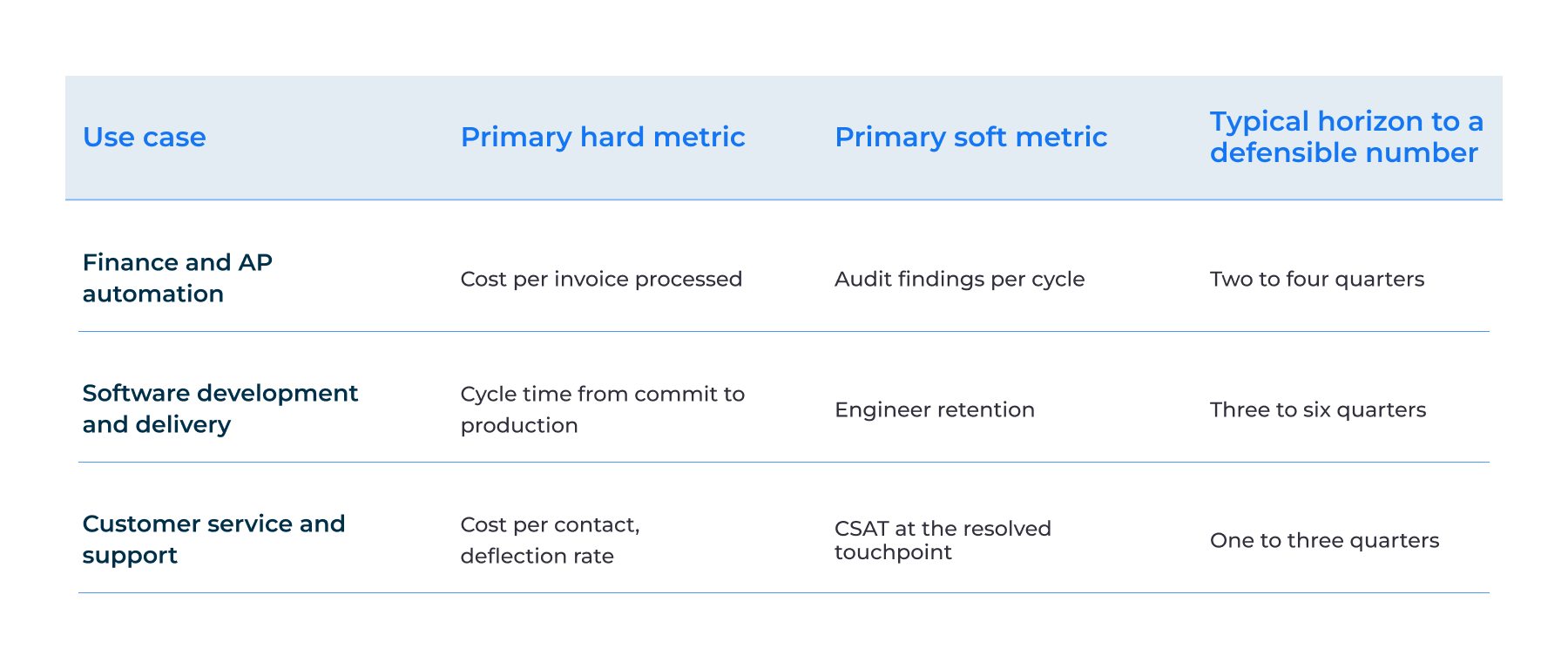
Finance and accounts payable
Invoice matching, coding, exception routing, and approval chasing are high-volume work with a clean baseline already sitting in the ERP. So, it makes this the easiest place in most companies to prove a return.
AvidXchange's 2026 survey of finance leaders found 39 percent reporting improved accuracy and fewer errors, and 42 percent saying teams completed work faster. Error reduction is usually the bigger line, since a mis-coded invoice costs far more downstream than it does to fix at intake.
Watch the exception queue. A system that clears 71 percent of invoices cleanly and dumps the rest on two people in an unstructured pile has moved the work rather than removed it.
Software development and product delivery
Returns here concentrate in the parts of delivery nobody demos. Code review, test generation, environment setup, dependency triage, and the request queue that pulls engineers off roadmap work every afternoon.
Intellectsoft's AI practice reports 30 to 50 percent operational cost reduction across engagements. Routine requests are resolved without a developer touching them in 80 percent of cases, with developer workload down 70 percent on the workflows targeted. The mechanism behind those numbers matters more than the numbers: the gain comes from removing whole categories of interruption, not from typing code faster.
That distinction is why the METR finding sits alongside these figures without contradicting them. Assisted typing on unfamiliar code can slow an experienced engineer down. Removing forty interruptions a week from that same engineer does not.
Customer service
Fastest payback of the three, and the most frequently overstated. Deflection rate is easy to move and easy to fake — a contact that gets deflected and returns two days later as an escalation has reduced the cost.
Measure resolution rather than deflection. Contacts fully closed without human involvement, reopen rate within seven days, and CSAT measured on the resolved subset rather than across all traffic. Do that, and the number survives a CFO's questions. Skip it, and the business case collapses the first time someone pulls the reopen data.
How Intellectsoft Helps You Achieve Measurable AI ROI
Whether an AI program produces a number a CFO will accept is usually decided at the seams: where the system meets the data it depends on, and where its output lands in the process that has to consume it. Intellectsoft works those seams first. Mapping them before anything gets built is what makes the return measurable later, and it is the part of an AI engagement that rarely appears in a vendor demo.
Architecture before code. Every engagement with our AI development company opens with a discovery and systems-design sprint. The output is a map of
- where your data actually lives;
- which integrations will cost more than expected;
- what the current unit economics of the target process are;
- which constraint will cap the return before any model is chosen.
Teams that skip this step do not save time. They pay for it in year three, in technical debt that raises the price of every use case after the first.
That sprint also produces the baseline the whole business case depends on. Capture it while the old process is still running, and you can prove the delta later; capture it afterward and you are negotiating with the CFO from memory.
Proof of concept before you scale. A PoC scoped against one process, with kill criteria written before it starts and financial checkpoints agreed in advance. It answers a narrow question — does this specific workflow move, on our real data, at our real volume.
Intellectsoft's AI development services run that path from discovery through production, with a principal architect on the engagement rather than only in the pitch. Being mid-size by design is what makes that possible: 200 to 300 engineers, dedicated practice leads in AI, Cloud, Data, and Design, and enough selectivity to decline work that will not produce a result.
Outcomes reported in the customer's own numbers. Senior technical ownership took one client's data warehouse to ten times its previous performance and cut cloud spend by more than 40 percent. A global banking-technology provider consolidated risk management onto a unified AI platform, with manual review effort down 30 to 35 percent, model accuracy up roughly 25 percent, and risk processing up to 40 percent faster. NPS of 80 across a client base that includes EY, Harley-Davidson, London Stock Exchange, and Qualcomm.
Where to start. An AI assessment maps your highest-leverage use cases against the baselines you can actually instrument, sizes the full investment including the lines vendors leave out, and gives you a defensible model before you commit budget. Explore the AI practice or book an assessment, and bring the process you already suspect is the right one — that instinct is usually correct, and the work is proving it in numbers your board will accept.
FAQ
What is a good ROI for an AI project?
Anything above your internal hurdle rate over a defined multi-year window, which for most enterprises means 15 to 25 percent annualized. Chasing the 300 percent figures in vendor case studies is a mistake — those are almost always single-pilot numbers with build costs excluded. A more useful benchmark is your own prior automation work, since it shares your data estate and your change-management overhead. Only 6 percent of organizations in Deloitte's survey reached a positive return within twelve months. So, a first-year figure near zero is normal rather than alarming.
How long does it take to see ROI from AI?
Two to four years for enterprise programs, against seven to twelve months for conventional technology. Generative use cases move faster and should show a defensible number within two to four quarters. Agentic programs typically need three to eight quarters, because the first process carries the platform build and the compounding only starts with the second and third.
What's the difference between hard and soft AI ROI?
Hard returns reconcile to the general ledger — contractor hours removed, vendor contracts reduced, rework avoided at a known price per incident, revenue from capacity that did not exist before. Soft returns are measurable but not yet monetized: retention, decision speed, customer satisfaction, compliance posture. Both belong in the business case. Soft figures should carry an explicit confidence discount of 40 to 60 percent, shown in the model rather than applied quietly.
How much should a company budget for AI investment?
McKinsey's 2026 survey found 28 percent of organizations spending more than a tenth of their IT budget on AI, and more than half of the high performers spending above 15 percent. The split inside that number matters more than the total. Licensing is rarely the largest line. Integration, data readiness, and ongoing maintenance usually exceed it combined, and maintenance alone runs 15 to 25 percent of AI investment annually. Budgeting only for the tool is the most common way a program runs out of money at the integration stage. People are the other line that gets underestimated: the cost of building an AI team — engineers, data work, and the practice leadership to direct both — is what decides whether the integration and maintenance lines above are covered internally or bought in.
Can you estimate AI ROI before full implementation (proof of concept)?
Yes, within a range, and the estimate improves sharply if the baseline is captured before the proof of concept starts. A well-scoped PoC produces four inputs:
- accuracy against a human benchmark;
- unit time on real volume;
- exception rate;
- integration effort discovered rather than assumed.
Those four let you calculate ROI for production with a confidence band — typically plus or minus 30 percent at that stage. The band narrows as volume rises. What a PoC cannot tell you is the adoption rate. Adoption is the variable that decides AI ROI more often than any other.